- custom 3D printed electronics enclosure Miami
- Custom electronics housings and mounting components built around your fitment needs
- What Custom3Dmodel can make for electronics and electrical component projects
- Custom 3D printed electronics enclosure Miami projects: common applications
- Outlet-strip, power-strip, and electrical socket cover replacements
- Electronics project boxes and component housings
- Mounting plates, structural brackets, and replacement functional parts
- ASA carbon fiber 3D printing for strong, precise custom housings
- Choosing ASA carbon fiber, ABS, PETG, FDM, or SLS for a functional enclosure
- When ASA carbon fiber is a practical choice
- When ABS or PETG may be the better enclosure material
- When SLS functional parts are worth considering
- Engineering a 3D printed electrical housing for fit, assembly, and durability
- From measurements to a finished functional part: Custom3Dmodel’s workflow
- Practical project example: black ASA carbon-fiber enclosure with custom cutouts
- Why work with a Miami-based custom functional-part partner
- Frequently asked questions about custom 3D printed electronics enclosures
- Can you make a custom enclosure from photos or a broken part?
- Can a 3D printed enclosure include screw holes, connector cutouts, and internal supports?
- Is a 3D printed power-strip housing safe for mains-voltage use?
- What affects the turnaround time and price of a custom enclosure?
- Request a Miami quote for a custom 3D printed electronics enclosure
- Custom 3D Printed Electronics Enclosure Miami: Design Options by Application
- Resources & Useful Links
custom 3D printed electronics enclosure Miami
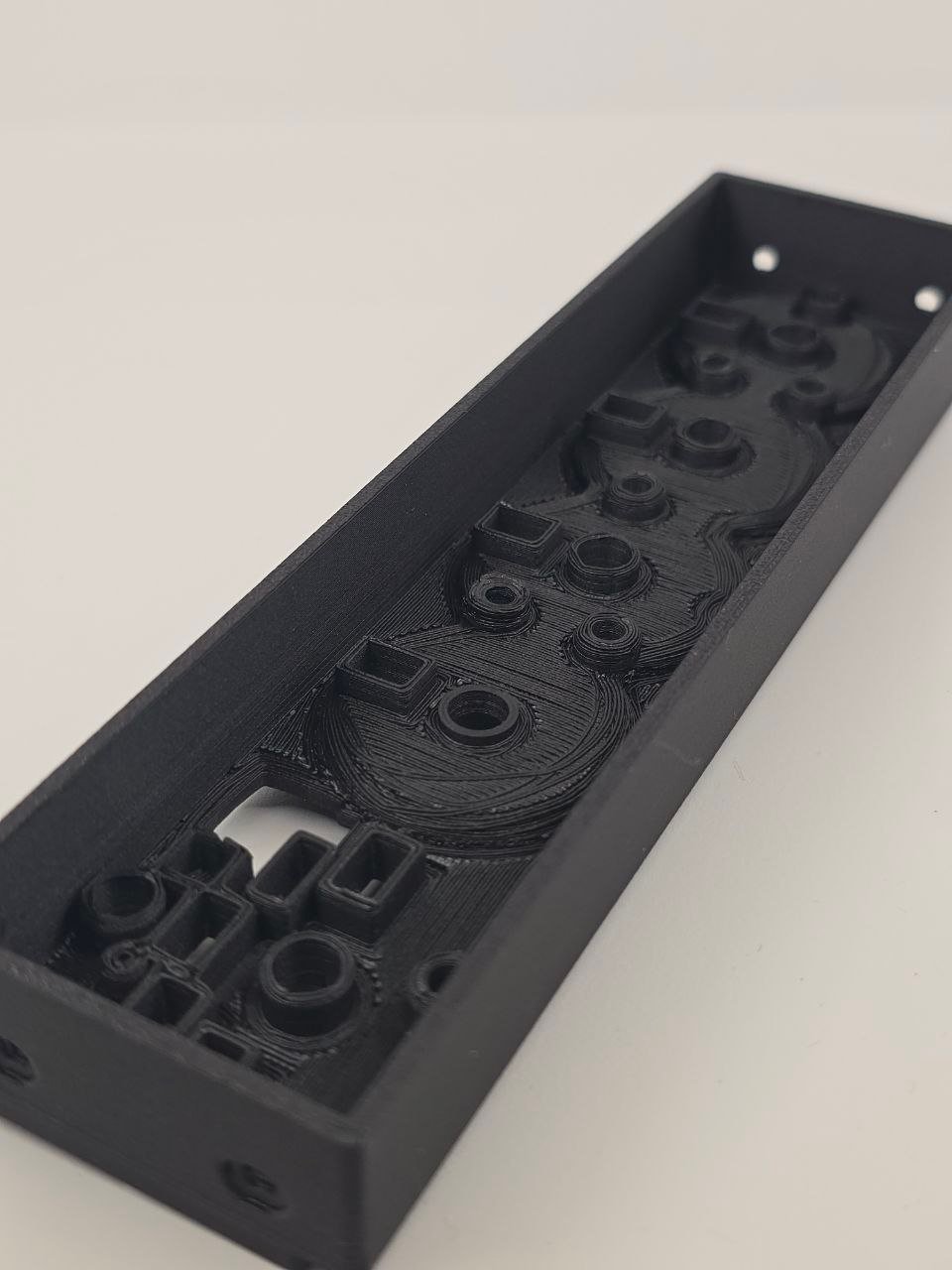
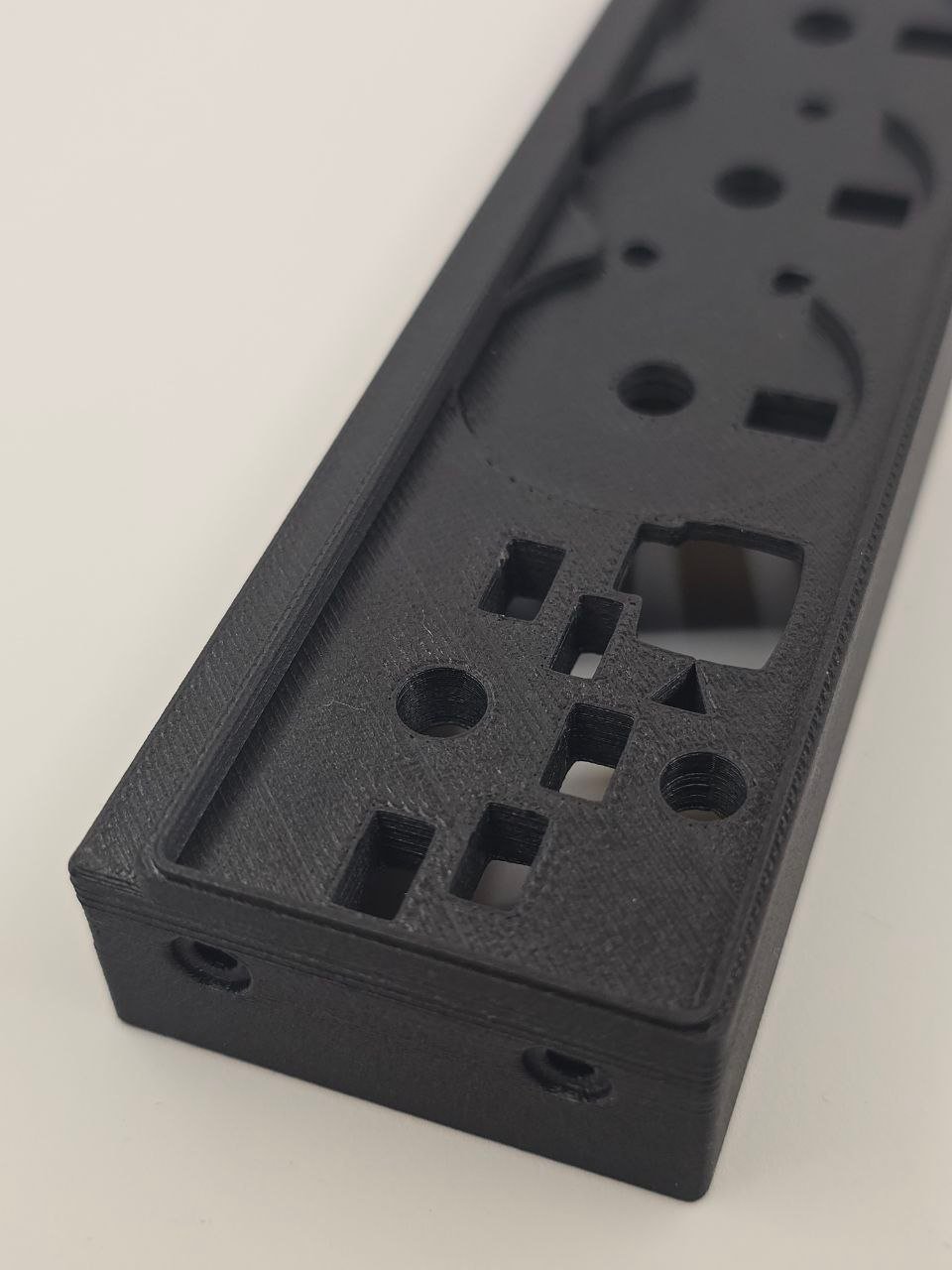
A custom 3D printed electronics enclosure Miami project should start with the real component layout—not a generic project box. Custom3Dmodel produces made-to-fit housings, outlet-strip covers, mounting plates, brackets, and replacement functional parts around actual cutouts, hardware, internal clearances, and installation conditions. For this type of work, a black ASA carbon-fiber rectangular enclosure is a practical example of how custom geometry can combine a clean exterior with screw holes, connector openings, and interior assembly features.
Custom electronics housings and mounting components built around your fitment needs
For a custom 3D printed electronics enclosure Miami customers need, physical fitment is usually the first requirement. A homeowner replacing a damaged outlet-strip shell, a maker building a controller box, or a product team testing a device cannot rely on an off-the-shelf enclosure when connector positions, mounting patterns, or available installation space are nonstandard.
Custom3Dmodel reviews the details that determine whether a part will assemble correctly: circular and rectangular cutouts, PCB standoffs, cable exits, lid interfaces, screw bosses, recessed fastener locations, mounting tabs, and access openings for switches or displays. Internal space matters as much as the outside dimensions. A connector may clear the wall while its cable plug still needs more room for bend radius and removal.
Customers can start with a production-ready STL or CAD model, a broken sample, a hand sketch, photos with measurements, component data sheets, or an early concept requiring modeling support. When dimensions are uncertain, a fit-check prototype is often the most efficient way to avoid repeating a full-size finished enclosure.
What Custom3Dmodel can make for electronics and electrical component projects
Custom3Dmodel makes rectangular component housings, 3D printed electrical housings, protective covers, wall-mount interfaces, and custom plastic replacement components. Typical requests include a custom 3D printed enclosure for a controller, a 3D printed component housing for an adapter or display, a 3D printed electrical socket cover, and a 3D printed outlet strip housing with the correct openings and fastener pattern.
Mounting hardware is another common need. A 3D printed mounting bracket can adapt an electronic device to an existing wall, cabinet, equipment frame, or panel. A 3D printed mounting plate can convert a nonstandard hole pattern into a usable installation interface. These are functional 3D printed parts, so load direction, screw type, layer orientation, and wall thickness need attention before appearance-focused details.
One-off prototypes are useful when a customer needs to confirm assembly or installation. After fitment is validated, the same design can move into small-batch production for repeat installations, product development, or custom 3D printed replacement parts. Review our custom 3D printing services for functional parts and prototypes when selecting the right path for a housing or mounting project.
Custom 3D printed electronics enclosure Miami projects: common applications
Custom3Dmodel supports Miami, Florida customers needing enclosure prototypes, replacement housings, and short-run functional production. South Florida customers may be able to provide a sample part for measurement, while customers outside the area can send detailed photographs, dimensional references, and CAD files for review. The goal is to make the enclosure match its actual assembly rather than force components into a stock box.
Outlet-strip, power-strip, and electrical socket cover replacements
A 3D printed power strip housing or 3D printed outlet strip housing may be requested when an exterior shell, cover, mounting tab, or protective plastic component is cracked, missing, or discontinued. Before modeling, it is important to document every outlet opening, switch location, cord exit, plug clearance, ventilation feature, screw position, and wall-mount interface. A few millimeters of error can prevent the assembly from closing or leave a switch inaccessible.
A printed replacement is a physical component, not an automatic safety certification. A 3D printed electrical housing is not inherently electrically rated, flame rated, waterproof, UL listed, or approved for mains-voltage use. Electrical insulation, heat management, regulatory requirements, and final application safety must be evaluated for the specific assembly by appropriately qualified parties.
Electronics project boxes and component housings
Controllers, sensors, power modules, displays, adapters, and early-stage product electronics often need a custom housing before final manufacturing tooling makes sense. Electronics enclosure 3D printing Miami projects can include lid screws, PCB standoffs, connector cutouts, cable-routing channels, access ports, and removable covers. Snap-fit features can work in selected designs, but they need appropriate material, thickness, and geometry; a thin snap arm in a fiber-filled material may not be the right solution.
Internal-clearance validation is essential. In practice, Custom3Dmodel checks the board outline, tallest components, connector overhang, screw-head clearance, wire paths, and the sequence required to install the electronics before committing to a final batch.
Mounting plates, structural brackets, and replacement functional parts
A 3D printed mounting bracket can secure a device where the original mounting pattern does not match the installation surface. Other projects involve a 3D printed mounting plate for a panel, a replacement support for a discontinued device, or an organizer that positions several components cleanly. Functional part 3D printing Miami work is driven by the mechanical details: hole spacing, fastener size, expected load, leverage, mounting surface, and print orientation.
For custom 3D printed replacement parts, copying only the visible shape is rarely enough. The underside may need locating tabs, ribs, counterbores, clips, or reliefs that control how it seats against the existing assembly.
ASA carbon fiber 3D printing for strong, precise custom housings
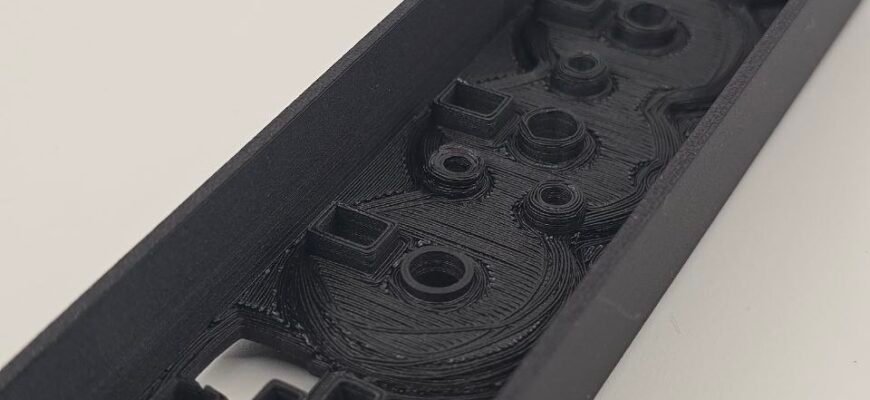
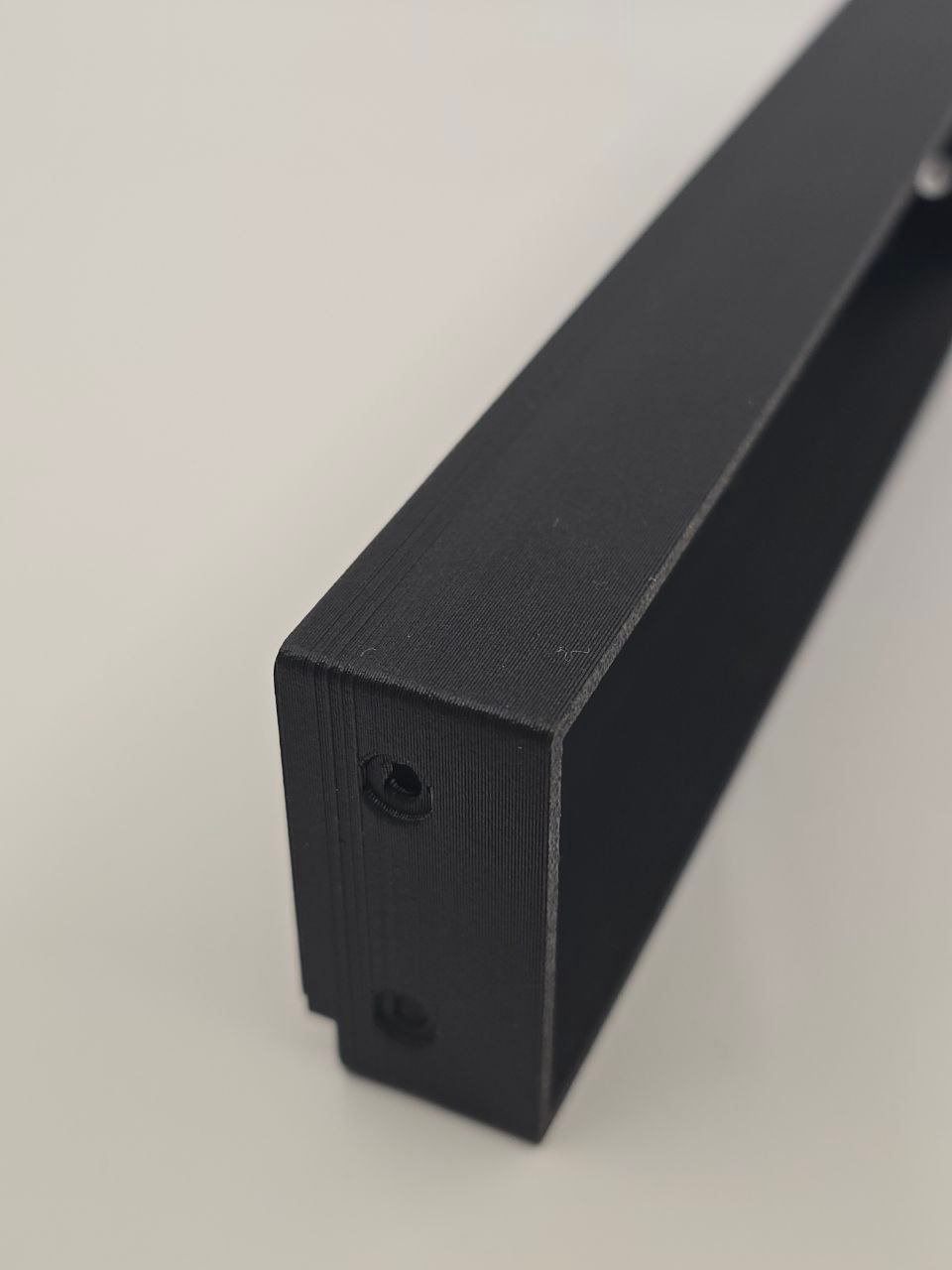
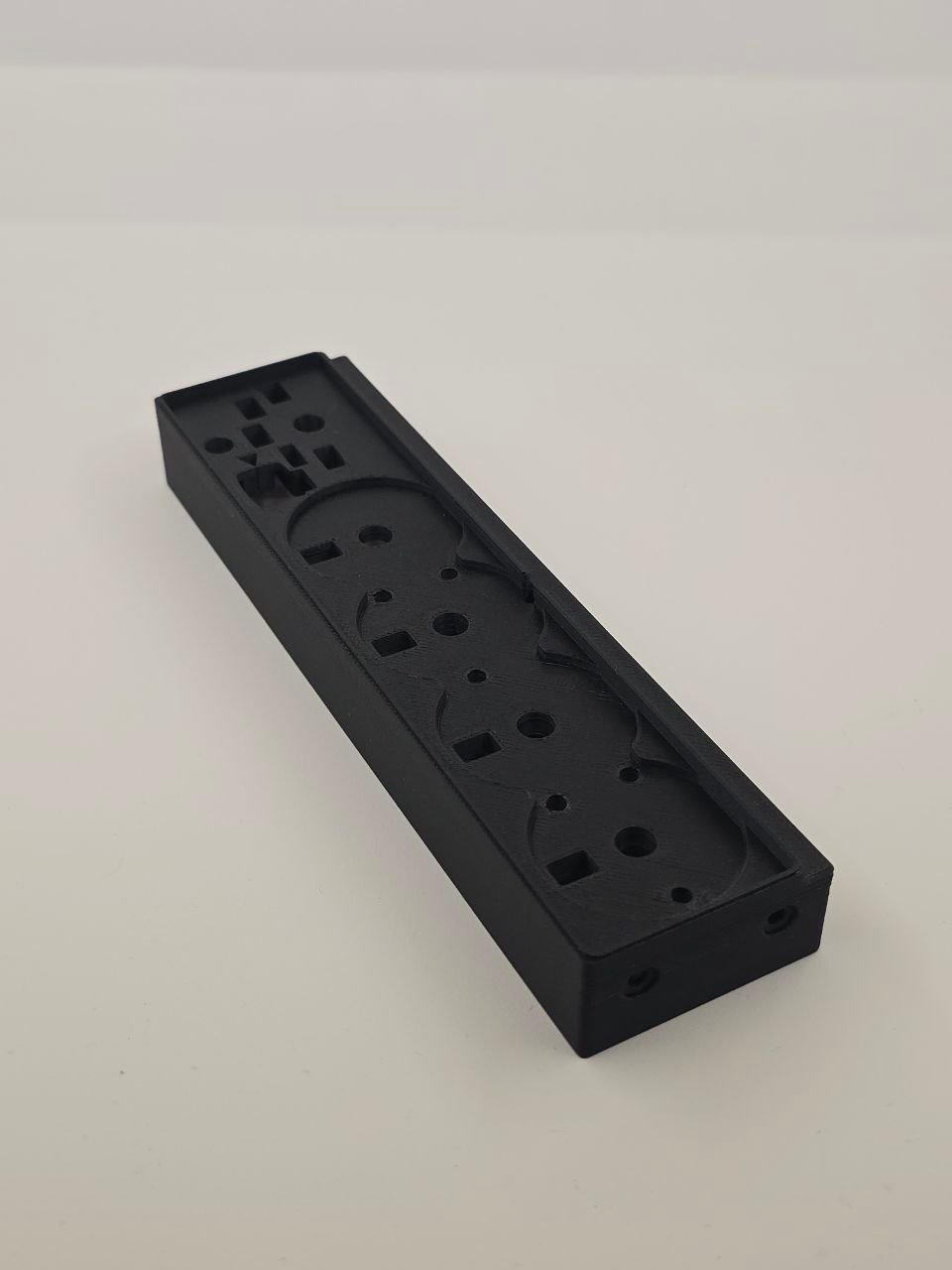
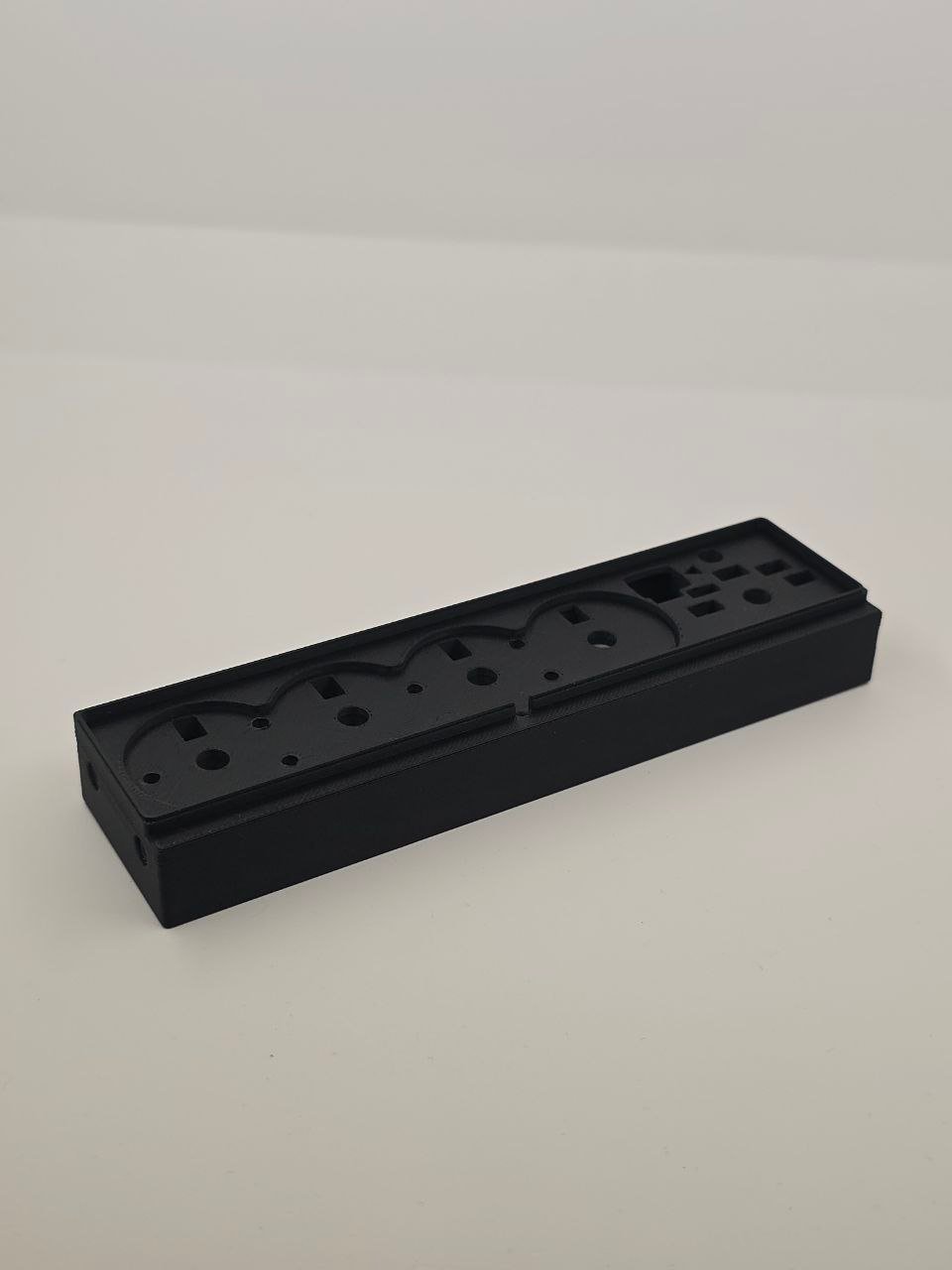
ASA carbon fiber 3D printing is a useful option for rigid enclosure shells, mounting interfaces, plates, and bracket-like parts where stiffness and a professional black finish are priorities. The black ASA carbon-fiber enclosure featured for this type of project uses a rectangular form with circular and rectangular cutouts, screw holes, and internal structures that support component placement and assembly.
Carbon-fiber reinforcement can increase stiffness and help reduce warping compared with an unfilled material, which can be valuable for broad flat plates, long enclosure walls, and fitment-sensitive mounting features. It also produces a darker, more technical-looking surface than many standard filaments. However, stiffness is not the same as universal durability. A carbon-fiber reinforced part is not automatically impact-proof, electrically safe, heat-rated, waterproof, or appropriate for a compliance-critical installation.
At Custom3Dmodel, the material decision follows the actual part. The intended load, installation location, exposure to sun, expected temperatures, required finish, wall thickness, and whether a feature must flex repeatedly all affect the recommendation. ASA carbon fiber is often a strong candidate for a rigid custom housing, but it is not automatically the best choice for every clip, living hinge, or high-impact component.
Choosing ASA carbon fiber, ABS, PETG, FDM, or SLS for a functional enclosure
Material selection for a custom 3D printed electronics enclosure Miami project should be application-specific, not a generic filament comparison. FDM 3D printing for functional parts is often the cost-effective choice for housings, brackets, rapid revisions, and small batches because it supports practical wall thicknesses, threaded-insert features, and straightforward design changes. SLS 3D printed functional parts may be considered when geometry or production requirements make powder-bed manufacturing a better fit.
Custom3Dmodel can review the required stiffness, impact behavior, temperature exposure, finish, outdoor considerations, dimensional interfaces, quantity, and budget. This is a fabrication and design-support recommendation, not electrical engineering or product certification.
When ASA carbon fiber is a practical choice
ASA carbon fiber is practical for rigid enclosure shells, mounting interfaces, and bracket-like geometries that benefit from controlled shape and stiffness. Fiber-filled filaments are abrasive and require suitable processing and wear-resistant print components. Their added stiffness also means they are not ideal for every thin, repeatedly flexed feature. A latch may need a thicker section, a different geometry, or another material.
ASA is often considered for sun-exposed applications, but actual outdoor performance still depends on exposure level, part geometry, wall thickness, fastening method, and project-specific requirements. It should be selected deliberately rather than treated as a blanket weather-resistance claim.
When ABS or PETG may be the better enclosure material
An ABS 3D printed enclosure can be a sensible functional option when balanced toughness and heat performance are relevant. ABS needs controlled processing for consistent results, especially on larger enclosures with long walls or broad flat surfaces. Its suitability still depends on the design and operating environment.
A PETG 3D printed electronics housing is often practical for general-purpose protective covers, project boxes, and brackets where toughness and straightforward functional printing are useful. Neither PETG nor ABS alone establishes suitability near energized systems, elevated heat, flame exposure, or code-regulated installations. Those requirements must be separately evaluated for the completed assembly.
When SLS functional parts are worth considering
SLS functional parts are worth considering for complex production-oriented geometry, nested assemblies, or designs that benefit from support-free powder-bed printing. The process has different surface texture, material options, economics, and lead-time considerations than FDM. SLS is not inherently more accurate or stronger in every application; the best process depends on the dimensions, interfaces, part behavior, finish expectations, and quantity required.
Engineering a 3D printed electrical housing for fit, assembly, and durability
A reliable 3D printed electrical housing begins with the component envelope. The CAD model should account for board dimensions, connector locations, socket and switch positions, cable bend space, fastener locations, access requirements, mounting surfaces, and the actual assembly sequence. A housing that looks correct externally can still fail if a cable cannot turn inside the cavity or a lid cannot be installed after the board is mounted.
FDM construction is directionally stronger along printed roads than between layers. For that reason, wall-mounted brackets, screw bosses, tabs, and load-bearing arms should be oriented so the expected force does not repeatedly pull layers apart. A mounting plate may print flat for a clean profile, while a heavily loaded bracket may need a different orientation or a revised rib structure to support the load path.
Wall thickness should be selected around the part’s job, not simply minimized to save material. Enclosure walls need enough structure to resist handling and retain screws without becoming unnecessarily bulky. Mating covers need clearance allowances; a nominally exact CAD fit may bind after printing. Hole sizes may be adjusted for the intended fastener, whether it is a through-bolt, a self-tapping screw, a heat-set insert, or a captured nut.
Fillets reduce stress concentration at the base of brackets and screw bosses. Support strategy should be considered before printing because supports can affect surfaces around cutouts or interior cavities. Some parts need cleanup, insert installation, deburring, or light sanding after printing. For socket openings, connectors, switches, boards, or existing wall surfaces, a prototype fit check is usually more valuable than assuming every tolerance will behave the same way in the first production run.
From measurements to a finished functional part: Custom3Dmodel’s workflow
For a custom 3D printed electronics enclosure Miami project, Custom3Dmodel begins by reviewing the use case and available references. Useful inputs include an STL or CAD file, a sketch, photographs with a ruler or known-size reference, a component data sheet, screw specifications, exact measurements, a broken sample, and details about where and how the part will be installed.
The review confirms cutout locations, mating surfaces, internal clearances, mounting needs, tolerances, cable paths, and intended use. From there, the team can recommend ASA carbon fiber, ABS, PETG, or another suitable route based on the actual part rather than a default material choice. If the enclosure interfaces with an existing assembly, the design may include a prototype stage before final manufacturing.
Prototype-first logic limits risk: model or revise the housing, print the fit-check part where warranted, inspect the assembly, adjust clearances or feature locations, and then produce the final part or small batch. Customers who already have finished files can move directly into print review, while customers with only a damaged part or concept can request design assistance. To scope quantities, materials, and fitment requirements, use our instant 3D printing quote request with files and project notes.
Practical project example: black ASA carbon-fiber enclosure with custom cutouts
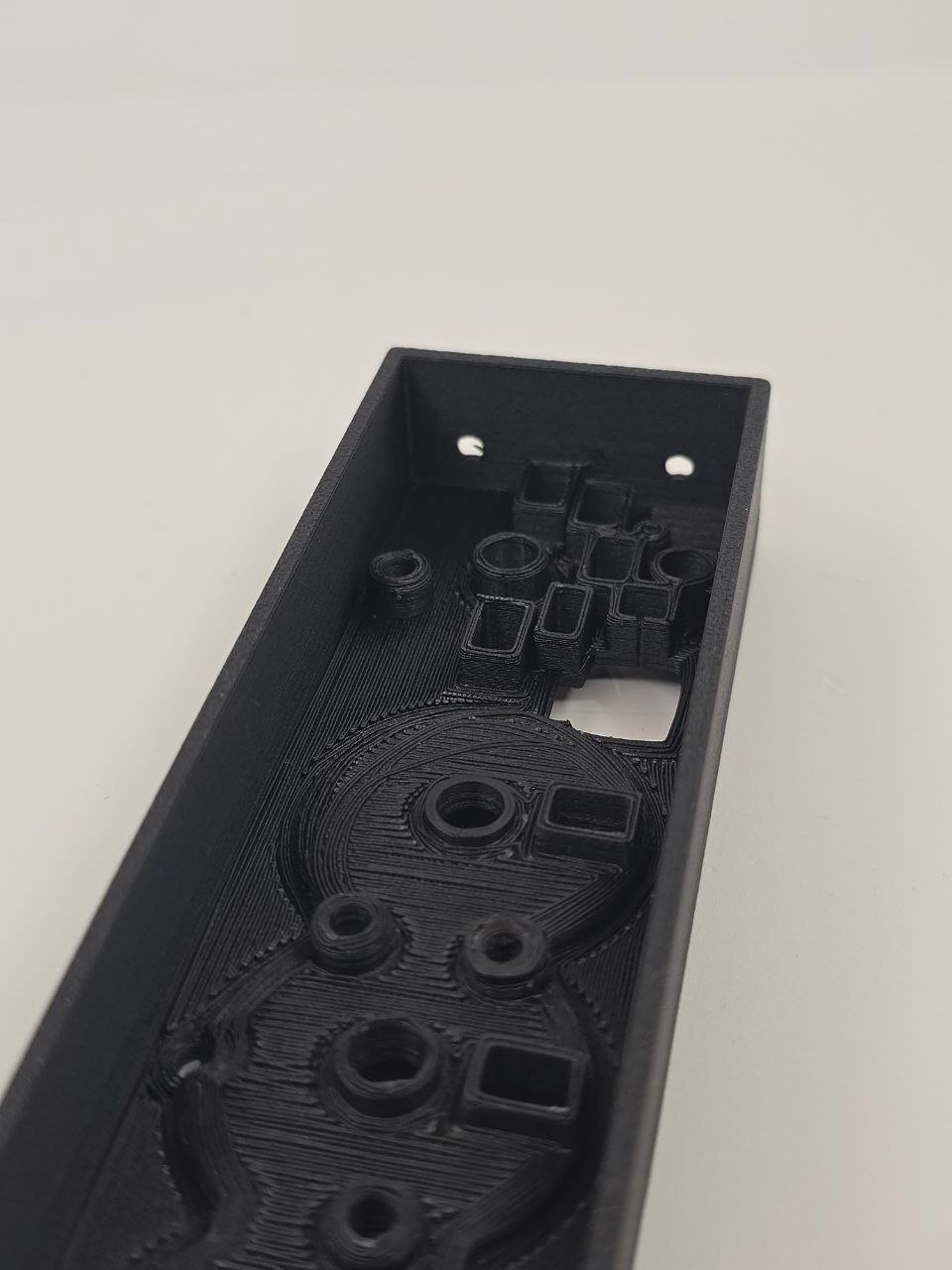
An anonymized ASA carbon-fiber enclosure workflow illustrates the process. First, the component arrangement and outside mounting requirements are inspected or measured. A rectangular housing is then modeled around the needed assembly, including circular and rectangular openings, screw holes, and interior support structures. These internal features can locate components, provide spacing from the enclosure wall, or support a lid and fastener sequence.
For the strongest project documentation, use original exterior and interior photos of the finished black enclosure. An exterior image should show the overall rectangular form, mounting holes, and cutouts. An interior image should identify standoffs, structural ribs, screw interfaces, and the arrangement that supports component assembly. These images help future users understand why the part was custom modeled rather than selected from a catalog.
Exact wall thickness, dimensional allowances, thread or insert strategy, operating temperatures, and post-processing requirements should be confirmed for each project. The example demonstrates a practical ASA carbon fiber 3D printing approach to custom geometry; it does not establish a universal performance rating or safety approval for another enclosure design.
Why work with a Miami-based custom functional-part partner
A custom 3D printed electronics enclosure Miami provider should focus on the details that make a functional part usable: fitment-critical dimensions, internal clearance, screw-hole specifications, cutout positions, cable paths, assembly order, and intended loads. Custom3Dmodel supports customers with production-ready files and customers who need a measured sample converted into CAD or a concept refined into a printable design.
For Miami and South Florida projects, the consultation can focus on the specific component and installation need rather than forcing a generic enclosure into place. Custom3Dmodel also works with customers who provide complete remote references for review, with shipping and service details confirmed through the quote process. The practical objective is a part that can be inspected, assembled, and produced with realistic manufacturing limitations understood upfront.
Frequently asked questions about custom 3D printed electronics enclosures
These answers address enclosure fabrication, fitment, material selection, and small-batch planning. Custom3Dmodel produces custom physical parts and design support; electrical certification, compliance testing, and electrical engineering remain separate requirements.
Can you make a custom enclosure from photos or a broken part?
Yes. Photos with measurements, a broken sample, sketches, and component dimensions can provide a starting point for 3D modeling and replacement-part development. Include multiple views, a ruler or known-size reference, mounting-hole spacing, connector locations, and the part’s intended function. If an interface is critical, a fit-check prototype may be recommended before the final version is produced.
Can a 3D printed enclosure include screw holes, connector cutouts, and internal supports?
Yes. A design can incorporate screw holes, recesses, PCB standoffs, cable exits, circular and rectangular cutouts, interior ribs, and other assembly features. Before production, Custom3Dmodel needs to know the fastener type, thread strategy, mating-component dimensions, clearance requirements, and expected load direction. Exact hole sizing may be adjusted for the selected print process and assembly method.
Is a 3D printed power-strip housing safe for mains-voltage use?
A custom printed power-strip housing is not automatically electrically rated, flame rated, UL listed, waterproof, insulated for a specific voltage, or approved for mains-voltage use. Electrical safety, thermal management, insulation, and regulatory requirements need review by appropriately qualified parties for the specific assembly. Custom3Dmodel’s role is to produce the physical enclosure or replacement component according to the reviewed design and material requirements.
What affects the turnaround time and price of a custom enclosure?
Key factors include whether CAD modeling is needed, part size, geometry, material, print process, required prototype iterations, quantity, finishing needs, and completeness of supplied measurements. Assembly-critical parts commonly move into small-batch production after fitment is validated. Submit files, photos, dimensions, and use details for a project-specific quote rather than relying on a fixed lead-time assumption.
Request a Miami quote for a custom 3D printed electronics enclosure
Send Custom3Dmodel your enclosure photos, dimensions, CAD file, or component layout to request a Miami quote for a custom 3D printed electronics housing, mounting plate, outlet cover, bracket, or replacement part.
Include intended use, overall and internal component dimensions, connector and cutout locations, screw specifications, mounting requirements, preferred material if known, quantity, and photos of any broken part or existing assembly. Miami and South Florida customers can request consultation for rapid prototyping or small-batch needs, while nationwide shipping availability can be discussed during the quote process. A complete reference package lets Custom3Dmodel evaluate the design, material, and manufacturing path with fewer assumptions.
Custom 3D Printed Electronics Enclosure Miami: Design Options by Application
| Enclosure Application | Key Design Features | Recommended Material | Recommended Print Technology | Best Use |
|---|---|---|---|---|
| IoT sensor housing | Cable pass-throughs, vent slots, PCB standoffs, snap-fit or screw-on lid | PETG or ABS | FDM | Smart sensors, monitoring devices, and connected controllers |
| Wall-mounted control box | Mounting ears, screw bosses, display opening, access panel | ABS or PETG | FDM or SLS | Building controls, automation panels, and low-voltage electronics |
| Outlet strip housing | Socket cutouts, cord exit, internal ribs, mounting channels | ABS | FDM | Prototype power-strip covers and electrical component housings |
| PCB mounting plate | Accurate hole pattern, standoffs, clip locations, cable-routing slots | PLA for indoor prototypes; PETG for durable parts | FDM | Rapid fit checks, custom control boards, and equipment retrofits |
| Equipment mounting bracket | Reinforced corners, gussets, slotted mounting holes, captive-nut pockets | PETG or ABS | FDM or SLS | Routers, small displays, power supplies, and custom electronics assemblies |
| Weather-protected electronics housing | Overlapping lid, gasket channel, drain holes, protected cable entry | PETG or ABS | FDM | Outdoor sensors and protected installations in Miami’s humid climate |
Resources & Useful Links
- 📚 Fused Filament Fabrication (FFF) — Background on the FDM/FFF process commonly used to produce custom functional enclosures, mounting plates, and brackets.
- 🏢 Prusa Knowledge Base: Material Guide — Official material-selection guidance for printable plastics, including practical considerations for PLA, PETG, ABS, and ASA functional parts.
- ⚙️ Protolabs: 3D Printing Design Guidelines — Engineering-oriented guidance on tolerances, wall thickness, feature design, and process limitations relevant to made-to-fit electronics housings and mounting components.
- 🎓 Autodesk: Design for Additive Manufacturing — Overview of design-for-additive-manufacturing principles that can help when planning cutouts, fastener locations, internal clearances, and structural features for custom enclosures.