- Custom 3D Printed Moai Head Planter Miami
- A Custom Moai-Inspired Planter for Miami Homes, Gifts, and Interiors
- Why Choose a 3D Printed Moai-Style Planter?
- Custom 3D Printed Moai Head Planter Miami Design Options
- From Reference Image to Finished Sculptural Planter
- Engineering a Functional Custom 3D Printed Moai Head Planter Miami
- Waterproofing and Live-Plant Use for 3D Printed Planters
- PLA, ABS, or Resin: Choosing the Right Material for a Moai Planter
- Print Planning and the Smooth Warm-Black Finish
- Moai-Inspired Planter Project Showcase
- Small-Batch 3D Printed Planters for Miami Retail, Design, and Hospitality
- Why Work With Custom3Dmodel for a Custom Decorative Planter?
- Frequently Asked Questions About 3D Printed Planters Miami
- Can Custom3Dmodel create a planter from my sketch, image, or 3D file?
- Is FDM or SLA resin better for a Moai-inspired planter?
- Can a 3D printed planter hold live plants and water?
- Can you add drainage holes to a custom head-shaped planter?
- Can I order small batches of 3D printed planters in Miami, Florida?
- Request a Custom Moai-Inspired Planter Quote in Miami
- Custom 3D Printed Moai Head Planter Options in Miami
- Resources & Useful Links
Custom 3D Printed Moai Head Planter Miami
A Custom Moai-Inspired Planter for Miami Homes, Gifts, and Interiors
A custom 3D printed Moai head planter Miami project gives homeowners, designers, retailers, and plant enthusiasts a way to combine greenery with a sculptural statement piece. At Custom3Dmodel, we can turn a sketch, reference image, rough concept, or usable 3D file into a simplified Moai-inspired planter designed around your preferred size, plant type, finish, and intended use.
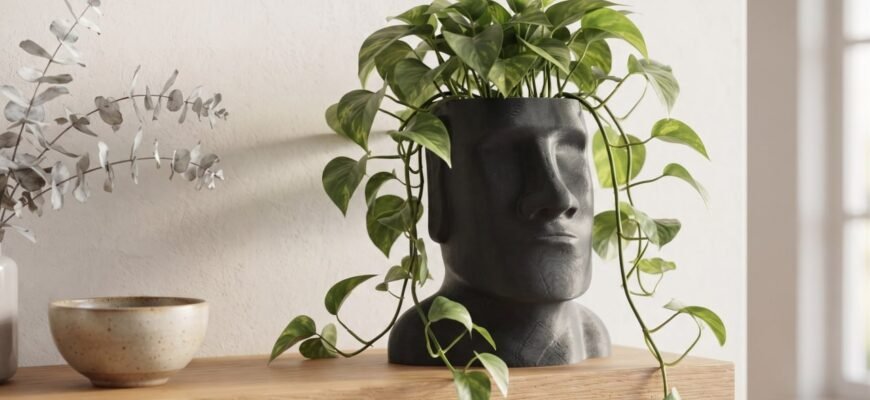
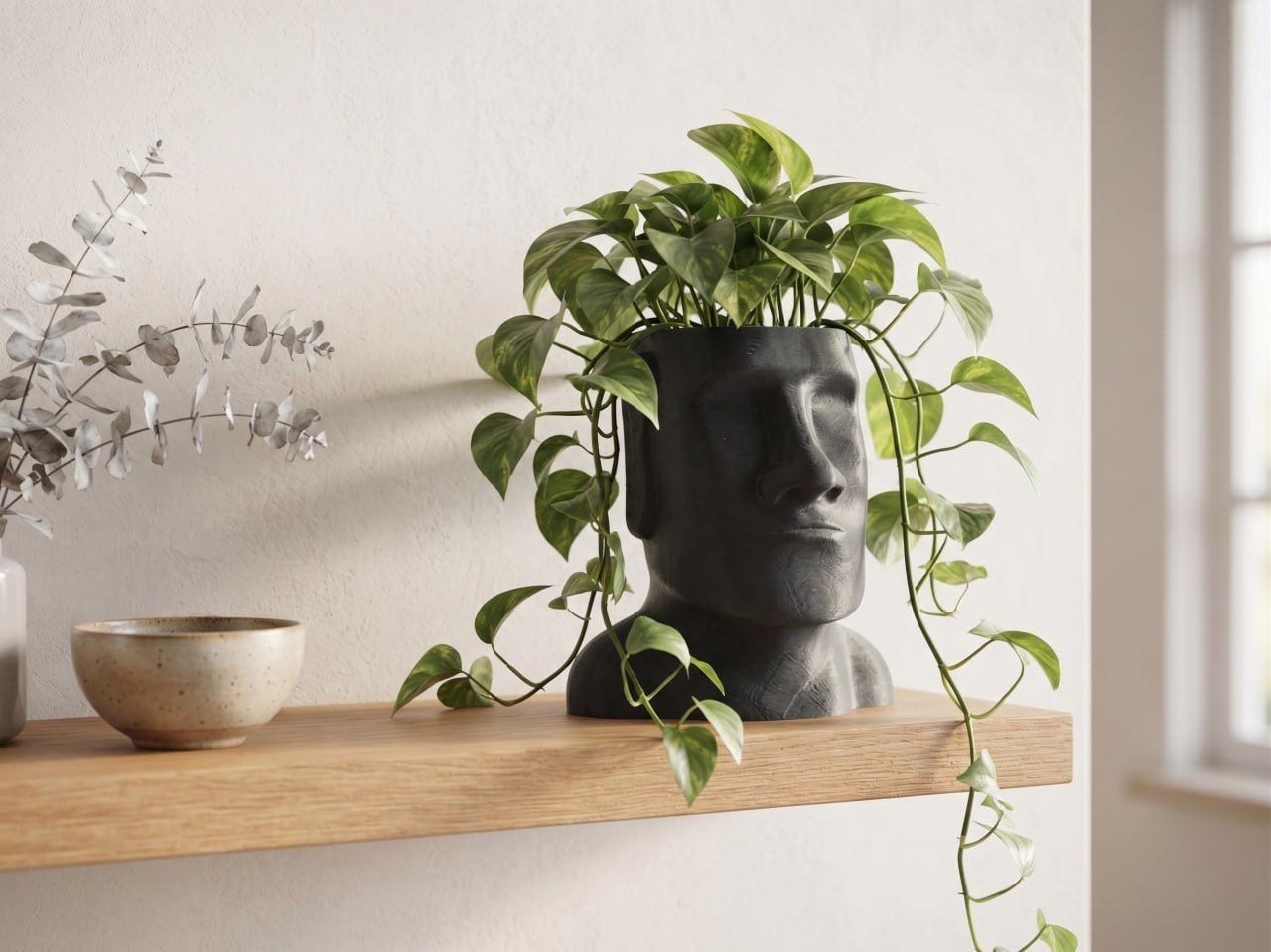
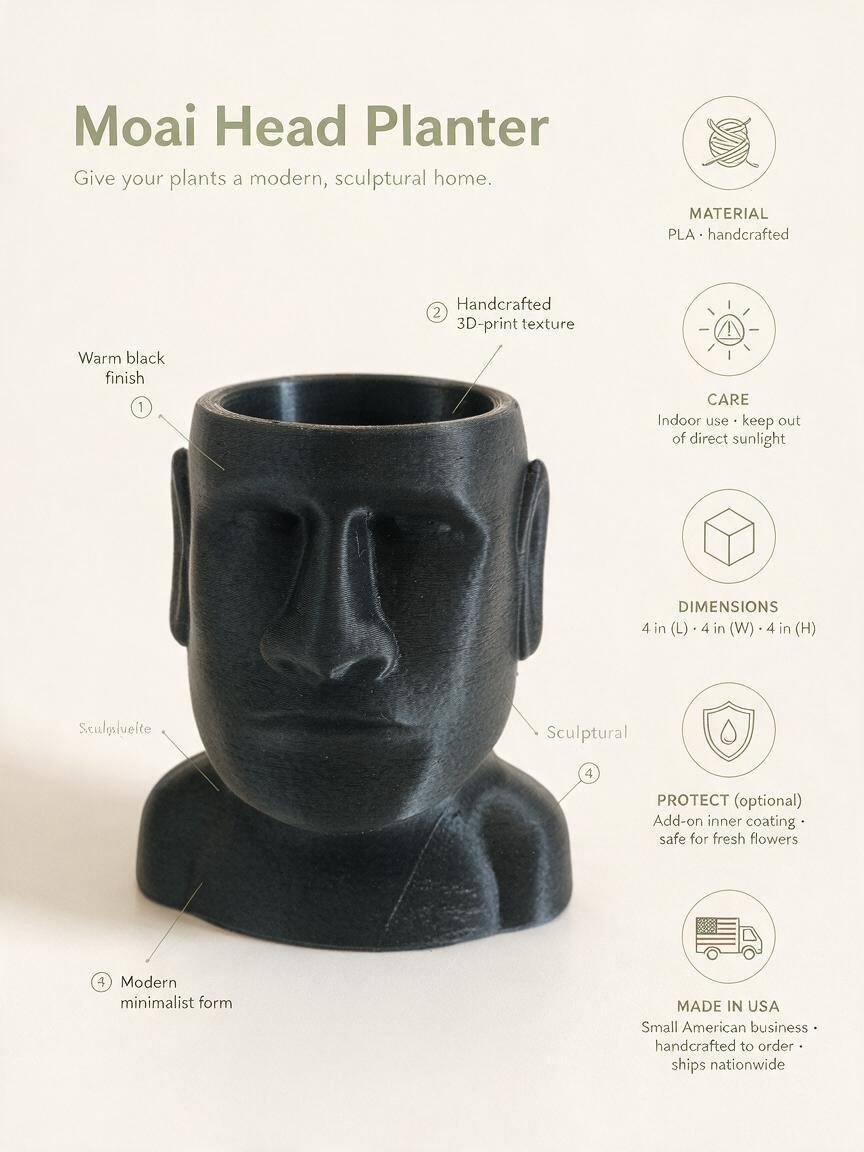
This is respectfully a Moai-inspired decorative design, not an authentic reproduction of a Rapa Nui or Easter Island artifact. The appeal comes from a clean, simplified facial profile, an architectural silhouette, and a top cavity that can frame trailing greenery such as pothos, philodendron, string-of-pearls, or artificial foliage. A smooth warm-black finish can make the piece read as a refined modern decorative object rather than a novelty planter.
Whether you are furnishing a Miami condo, creating an elevated gift, styling a restaurant reception area, developing boutique merchandise, or specifying an interior design feature, a 3D printed Moai planter can be built for the visual and functional requirements of the project. Custom3Dmodel provides custom 3D printing Miami clients can use for one-off display pieces, prototype development, and repeatable decorative production.
Why Choose a 3D Printed Moai-Style Planter?
Off-the-shelf planters force customers to accept a fixed cavity, color, footprint, and facial style. A custom head-shaped planter can instead be tailored to the available shelf depth, the diameter of an existing nursery pot, or the amount of trailing foliage the final display needs. That flexibility matters when a planter must fit a narrow console, a hospitality display, or a retail gift package.
A Moai-style planter 3D print can function as a custom indoor plant holder, a desk sculpture, or a modern decorative planter even before a plant is added. The cavity can be designed as a true planting volume, a concealed insert holder, or a decorative opening for preserved moss and artificial stems. Final dimensions, wall thickness, base geometry, and plant-weight capacity should always be confirmed during design review rather than assumed from photos alone.
For Miami interiors, where bright natural light and air-conditioned spaces create very different conditions from balconies or outdoor patios, intended placement should guide material and finish choices. We generally treat these as indoor decorative products unless the quote specifically addresses environmental exposure.
Custom 3D Printed Moai Head Planter Miami Design Options
With a custom 3D printed Moai head planter Miami order, Custom3Dmodel can support the project from concept through finished part. Clients may begin with inspiration images, a dimensioned sketch, an existing STL or OBJ, or simply a description of the desired look. Our Miami 3D modeling and printing service can create the model from scratch or adjust a supplied design so it is better suited to additive manufacturing.
Useful customization choices include overall height, face simplification, nose and brow proportions, cavity diameter and depth, rim thickness, back profile, base footprint, drainage-hole placement, saucer clearance, nursery-pot insert fit, and color. A warm-black painted finish is especially effective for this sculptural form, but matte charcoal, stone-inspired gray, metallic accents, or brand-specific colors are also possible depending on the production method and post-processing plan.
Before modeling begins, we recommend identifying the intended plant or insert. A small succulent needs little root volume but may need a shallow cavity; a pothos in a nursery pot needs enough internal diameter, access for removal, and a stable base once watered. For a decorative-only vessel, the cavity can prioritize appearance rather than soil volume. This project-specific approach is more reliable than selecting a generic model and hoping it works after printing.
As a 3D printing service Miami FL clients can consult locally, Custom3Dmodel can review practical requirements before production. Local pickup or delivery options may be available where confirmed during quoting, while completed eligible projects can also be shipped nationwide.
From Reference Image to Finished Sculptural Planter
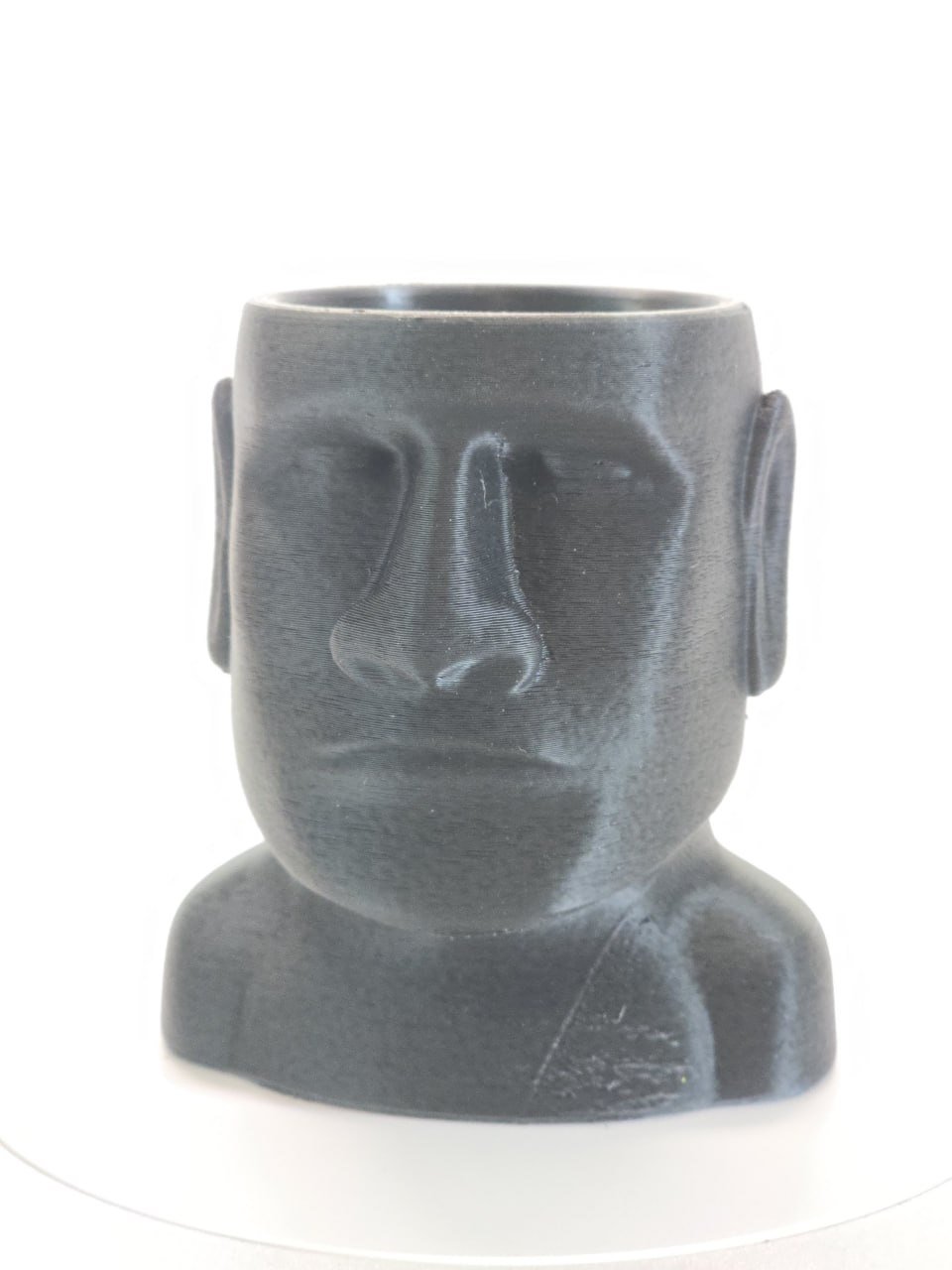
Our workflow starts with a concept review. Send reference images, a sketch, an STL, OBJ, STEP file, or other usable source material along with approximate dimensions and the intended use. For a custom 3D printed Moai head planter Miami project, we review the facial proportions, cavity access, base size, wall layout, and the areas most likely to require support material or finishing.
Next, Custom3Dmodel creates or refines the 3D model and makes design-for-additive-manufacturing adjustments. This can include thickening fragile edges, rounding sharp internal corners, increasing the planting rim, widening the footprint, modifying overhangs, or reserving clearance for a removable nursery pot. A digital model that looks correct on screen is not automatically a stable, cleanly printable planter, so these adjustments are an important part of the process.
A prototype is highly valuable for retail, hospitality, and product-development concepts. It lets the customer assess the silhouette, scale, cavity opening, planted appearance, stability, and finish direction before authorizing a larger order. After approval, the selected parts can move through printing, support removal, sanding, priming, painting, sealing when specified, and final production.
For accurate review, include quantity, desired dimensions, intended plant type, whether soil will be placed directly inside, finish preference, and whether you need drainage, sealing, or a removable insert. Explore our custom 3D printing and modeling services to see how modeling, prototyping, post-processing, and production support can fit the project.
Engineering a Functional Custom 3D Printed Moai Head Planter Miami
A custom 3D printed Moai head planter Miami design must be engineered as more than a decorative figure with a hole in the top. Cavity dimensions affect root space, soil volume, access for planting, and the size of any removable nursery pot. Wall thickness affects stiffness, print duration, material use, and resistance to handling. These variables need to work together with the final object height and visual proportions.
Weight is another key consideration. Dry potting mix is relatively light, but moist soil, water, a nursery pot, and mature trailing foliage can substantially change the load and center of gravity. A tall head-shaped form may require a broader or heavier base, adjusted internal geometry, or a reduced cavity depth to lower tipping risk. The correct solution depends on the approved size and how the planter will be used, not a universal weight rating.
Drainage should be selected intentionally. Direct drainage holes can work well when the planter will sit on a compatible saucer. A no-drainage exterior with a removable nursery pot may be cleaner for shelves, desks, and hospitality surfaces because the plant can be removed for watering. A decorative-only vessel should not receive soil and water directly unless its water-management method has been designed and approved.
Base geometry also affects practical use. We check that drainage openings do not weaken a narrow base, that a saucer has appropriate contact space, and that the planter can sit flat after post-processing. For display pieces intended to hold artificial plants, some of these constraints can be relaxed; for live plants, they should be addressed before the prototype is approved.
Waterproofing and Live-Plant Use for 3D Printed Planters
Standard FDM prints, including PLA, are not automatically watertight. Layer lines, seams, and small process variations can allow moisture to migrate through a print over time. For that reason, a waterproof 3D printed planter should never be assumed simply because it has thick walls or looks solid after printing.
For live indoor plants, the most practical approach is often a removable nursery-pot insert. It protects the outer decorative shell, makes watering easier, and allows the plant to be lifted out for maintenance. Depending on the design, we can also discuss a waterproof inner liner, a suitable sealant or coating system, or direct drainage holes paired with a saucer.
Even a sealed vessel needs thoughtful plant care. Standing water can lead to root problems, so the plan should account for drainage, watering habits, and the selected plant species. Custom3Dmodel can advise on a moisture-management direction based on the final geometry, material, print process, and coating plan, but waterproof performance should be validated for the specific approved design and use case.
PLA, ABS, or Resin: Choosing the Right Material for a Moai Planter
PLA is often the practical starting point for a PLA Moai head planter intended for controlled indoor use. It is cost-effective for FDM printed planter prototypes and many finished decorative pieces, and it can produce good results when the model is designed with realistic overhangs and finished properly. For larger forms, FDM also provides an efficient way to produce the main planter body without treating fine facial detail as the only priority.
ABS may be considered when improved heat resistance is important. For example, an interior object positioned near unusually warm glazing may call for a conversation about heat exposure and material behavior. ABS has different printing and finishing requirements, however, so it should be selected for a defined project need rather than as a blanket upgrade over PLA.
A resin Moai planter made through SLA can be an excellent option when fine facial transitions, sharper cavity-edge detail, and a smoother starting surface are central to the concept. Resin printing is often best suited to smaller refined pieces or components where detail justifies the added post-processing and handling considerations. It is not automatically the best choice for every large planter or watered vessel.
The FDM-versus-SLA decision should be based on final size, facial detail, surface expectations, budget, volume, intended environment, and whether a liner or insert will manage moisture. Custom3Dmodel evaluates those factors rather than pushing a one-size-fits-all material choice.
Print Planning and the Smooth Warm-Black Finish
Facial ledges, brow lines, the nose, chin contours, and the top cavity can create overhangs. Depending on the final orientation and geometry, support structures may be required beneath those areas. Orientation affects which surfaces show layer lines, where supports contact the model, the amount of cleanup required, and the strength of the finished part.
For a refined Moai-style planter 3D print, we plan layer height, wall settings, infill strategy, seam placement, and support contact points around the intended viewing angles. A front-facing display piece may deserve a different orientation than a planter designed to be viewed from all sides on a lobby pedestal.
The warm-black finish process can include careful support removal, sanding, filler or surface preparation where needed, primer, paint, and a selected protective topcoat. A regularly watered planter may require a different finishing plan than a dry display sculpture or retail gift item. Custom3Dmodel can recommend the appropriate route after reviewing the proposed use.
Moai-Inspired Planter Project Showcase
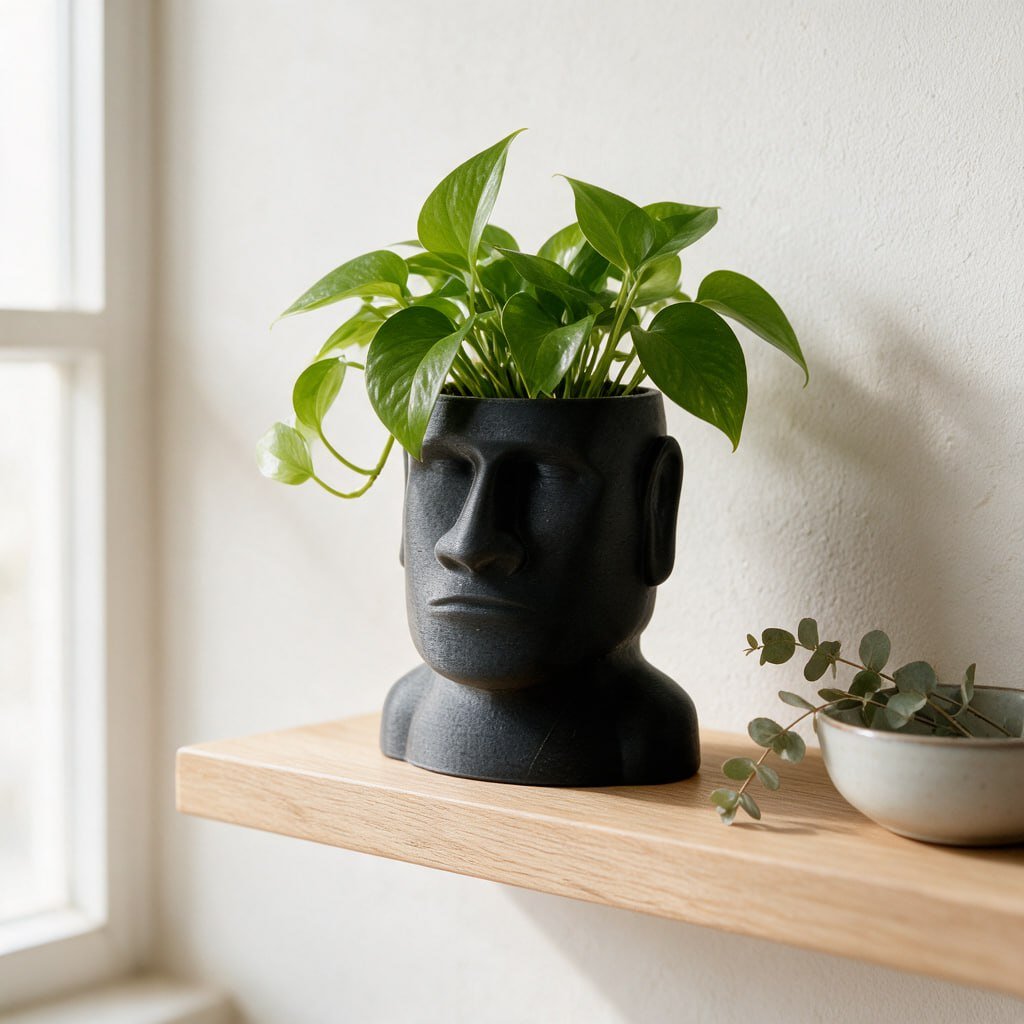
Our warm-black project showcase concept features a 3D printed sculptural planter with a simplified face, gently curved profile, top planting cavity, and trailing greenery that softens the architectural form. Recommended photography includes front, side, rear, cavity/interior, base, close-up finish, and planted-use views in a modern interior.
Useful image alt text includes: “warm-black Moai-inspired 3D printed planter with trailing plant in Miami modern interior” and “interior cavity and drainage design of custom 3D printed Moai head planter Miami.” Showcase imagery is illustrative; final size, cavity design, drainage, base geometry, material, color, finish, and quantity remain customizable for each customer project.
Small-Batch 3D Printed Planters for Miami Retail, Design, and Hospitality
Small batch 3D printed planters are a strong fit for boutique retail collections, interior design installations, hospitality decor, branded gifting, and early product launches. A prototype-first process helps validate visual consistency, customer handling, planting functionality, paint standards, packing needs, and repeatability before committing to a larger run.
Custom3Dmodel works as a custom home decor manufacturing Miami partner for prototypes and small-batch production, not as a substitute for unlimited-volume mass manufacturing. That distinction matters: additive production is particularly useful when you need design flexibility, controlled quantities, iteration, or multiple customized variations within a collection.
Businesses should provide target quantity, final dimensions, finish standards, intended use, packaging expectations, and any supplied design files during the quote stage. For planning costs and options, use our instant 3D printing quote request and include reference images whenever possible.
Why Work With Custom3Dmodel for a Custom Decorative Planter?
Custom3Dmodel brings a hands-on manufacturing perspective to decorative planter work: we look at cavity planning, wall thickness, base stability, facial overhangs, print orientation, material behavior, finishing, and moisture-management options before calling a design production-ready. Those details determine whether the finished object is merely attractive or also appropriate for its intended use.
As a Miami-based provider of custom modeling, FDM and SLA printing, post-processing, prototype refinement, and small-batch production, Custom3Dmodel collaborates with clients instead of making unsupported promises about every material or geometry. Recommendations are based on the approved model, intended environment, plant use, desired finish, and order quantity.
Miami clients can discuss local consultation, file review, and pickup or delivery options where available. Nationwide customers can also request eligible completed projects by shipping, subject to final quote and production confirmation.
Frequently Asked Questions About 3D Printed Planters Miami
Can Custom3Dmodel create a planter from my sketch, image, or 3D file?
Yes. Custom3Dmodel can review sketches, inspiration images, and compatible 3D files, then model or adapt the planter for printing. Before production, we confirm dimensions, cavity requirements, base geometry, facial detail, drainage approach, and whether it will hold a live plant or serve as decoration.
Is FDM or SLA resin better for a Moai-inspired planter?
FDM is often practical for larger decorative planters and PLA-based production. SLA resin can be better for smaller pieces where fine facial detail and a smoother starting surface are priorities. The right choice depends on size, finish expectations, budget, intended use, and post-processing requirements.
Can a 3D printed planter hold live plants and water?
It can be designed for live indoor plants, but standard printed parts are not automatically waterproof. A removable nursery-pot insert, liner, drainage-and-saucer system, or suitable coating should be selected based on the final design and expected watering routine.
Can you add drainage holes to a custom head-shaped planter?
Yes. Drainage holes and saucer compatibility can be incorporated during modeling, provided the base geometry remains stable. Clients who prefer a cleaner exterior or easier watering often choose a removable inner pot instead of planting directly into the printed shell.
Can I order small batches of 3D printed planters in Miami, Florida?
Yes. Small-batch production can be discussed for retail, design, hospitality, gifting, and prototype-to-product projects in Miami, Florida and for eligible nationwide orders. Provide quantity, dimensions, finish requirements, use case, and packaging expectations for accurate quoting.
Request a Custom Moai-Inspired Planter Quote in Miami
Ready to develop a custom 3D printed Moai head planter Miami project? Send Custom3Dmodel a reference image, sketch, or 3D file along with your desired dimensions, intended plant type, cavity needs, drainage preference, material direction, finish, quantity, and whether you need a decorative vessel, sealed planter, or nursery-pot insert.
We can help shape the concept into a polished prototype, a finished custom planter, or a small-batch decorative collection. Request a custom quote from Custom3Dmodel for Miami consultation and confirmed pickup or delivery options where available, or nationwide shipping for eligible completed projects. Turn a respectful Moai-inspired concept into a functional, refined home decor piece built for your display and plant-use goals.
Custom 3D Printed Moai Head Planter Options in Miami
| Moai Planter Style | Recommended Size | Best Plant Type | Material & Print Method | Ideal Use |
|---|---|---|---|---|
| Mini desk Moai | 3–4 in. tall | Air plants or tiny succulents | PLA, FDM | Desks, shelves, party favors, and small gifts |
| Classic Moai head planter | 5–7 in. tall | Succulents, cactus, or small pothos | PLA, FDM | Indoor plant holder and everyday home décor |
| Detailed stone-texture Moai | 6–8 in. tall | Faux plants or low-water plants | Resin, SLA | Premium display pieces and detailed custom gifts |
| Wide-opening Moai pot | 7–9 in. tall | Herbs, trailing plants, or larger succulents | PLA, FDM | Kitchen windowsills, entry tables, and living rooms |
| Custom face or logo Moai | 5–8 in. tall | Succulents or preserved moss | PLA or resin, FDM or SLA | Branded events, business gifts, and personalized décor |
| Drainage-hole planter | 5–7 in. tall | Live succulents and cactus | PLA, FDM | Practical indoor planting with a saucer underneath |
| Closed-base decorative Moai | 4–6 in. tall | Artificial plants or air plants | PLA, FDM | Low-maintenance décor for apartments and offices in Miami |
Resources & Useful Links
- 📚 Fused Deposition Modeling (Wikipedia) — Background on FDM/FFF printing, the common extrusion-based process well suited to producing custom PLA Moai-style planters and decorative objects.
- ⚙️ 3D Printer Filament Types Guide — A practical material comparison covering PLA, ABS, PETG, and other filaments, useful when selecting a material for an indoor decorative planter.
- 🏢 The Ultimate Guide to Stereolithography (SLA) 3D Printing — Official Formlabs overview of SLA resin printing, including its surface-quality advantages for detailed Moai-inspired figurines and sculptural planters.